AI @ UWE Bristol
Navigating ethical issues
Engaging with generative AI’s ethical implications is complex and often uncomfortable.
It is always going to be difficult navigating the ethics of frontier AI platforms like ChatGPT, Gemini, and Claude, when many people claim that their very foundations are inherently unethical. Whether it is using the work of others without consent, acknowledgement or compensation, or the huge environmental cost of training models, it is essential that we acknowledge the real impacts of these technologies and shape our individual and collective approaches accordingly.
Your approach
Your approach to AI will depend on your personal ethics and the external pressures you face. You might feel pushed to use these tools in particular ways, whether that pressure comes from colleagues, institutional demands, curriculum requirements, or professional expectations.
This is genuinely difficult. Some people have clear positions – either embracing or rejecting certain AI uses – but many of us feel conflicted. The reality is you’ll encounter many different AI technologies. Some you’ll use deliberately, while others might operate without your knowledge. Each presents its own ethical challenges. Some will be shared across all AI systems and some unique to specific tools.
When utilising AI in your teaching, you should agree a shared approach across your teaching team. For example, across your programme or professional services teaching team.
Influencing your ethical approach
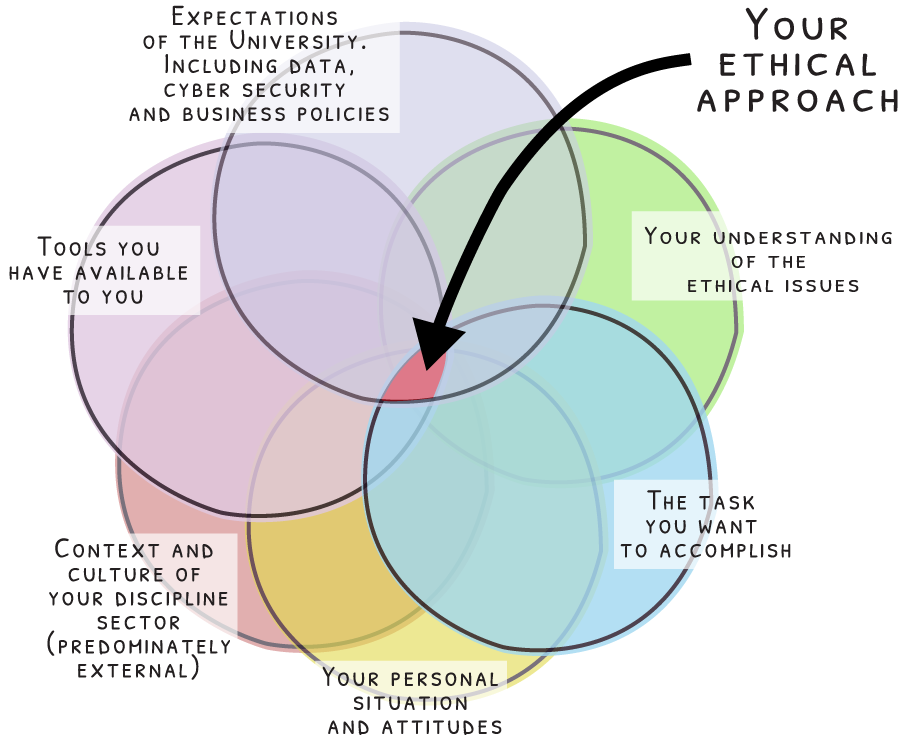
There will be many different factors influencing your ethical approach. These may include:
- Your personal situation and attitudes
- The teaching or research task you want to accomplish
- Your understanding of the ethical issues
- Expectations of the University, your school, department, programme and colleagues
- Context and culture of your discipline and professional field
- Tools you have available to you
You may find it useful to reflect on these factors. Which are more important to you? As factors change over time, how do they impact on your approach?
Responsible use of AI
Whatever activities we are engaged in at UWE Bristol, we are expected to practise them responsibly. That means being transparent about its use, being careful about the things we send to it and the things we do with its outputs.
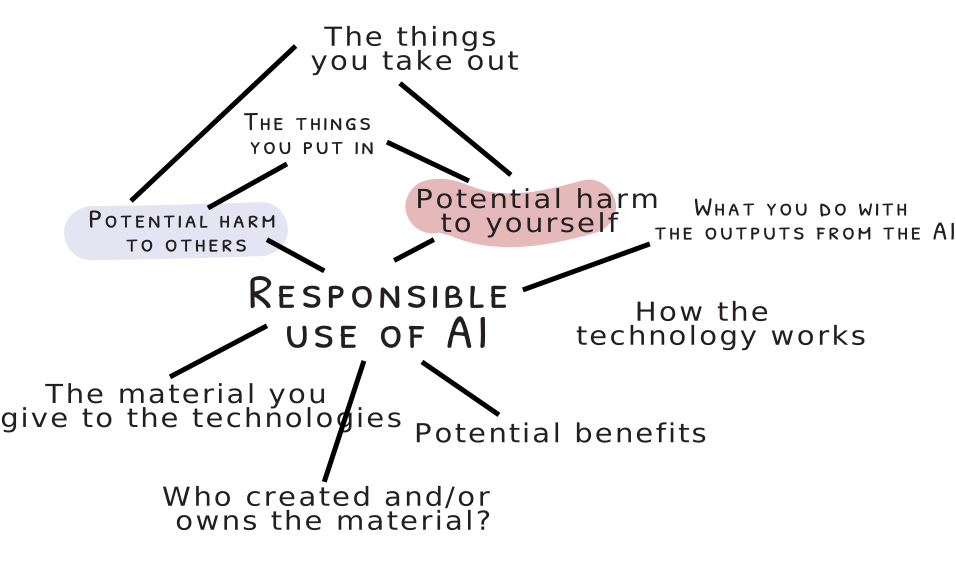
Potential harm to others
- The things you put in
- The material you are giving to the technologies (who created and/or owns the material?)
- The things you take out (what you do with the outputs from the AI)
Potential harm to yourself
- The things you put in
- The things you take out
Of course, it’s also necessary to consider potential benefits and how the technology works.
Can I just ignore the ethical issues?
Not really. As teaching staff, we’re expected to engage with our disciplines and their professional practices – including the challenges, debates, and attitudes around AI use specific to our fields.
You can only meaningfully engage with ethical debates from a position of knowledge. We encourage you to take a curious, research-based approach to exploring AI’s implications for your subject. This might involve using the tools yourself, or it might not.
Why does this matter?
Critical thinking is central to university teaching – and that includes thinking critically about the tools shaping your field and your students’ learning. AI has real consequences for your discipline, your teaching practice, and society. Understanding these impacts will deepen your professional expertise and enhance your ability to guide students.
How you engage with this will depend on both your disciplinary context and your own approach, but engagement itself isn’t optional.
Ethical behaviour in practice
Knowledge of ethical issues does not mean you are ethical. It’s all about practising what you know.
Key practical steps
- Practise responsible use of AI. Be mindful of your tool use and the effects it causes.
- You may feel pressure to personally take responsibility for issues that should really be addressed through regulation, changes in business practice, or improvements to the technology itself.
- Talk to others. Discuss AI use with colleagues, teaching teams, and others across the university. These conversations help you test your knowledge, challenge your assumptions, and reflect on your approach.
Thinking about ethical issues at university
Staff and students can rate some of the ethical issues associated with AI by completing our survey.
The live results are below. You can hover over each issue to see the spread of feeling.
Of course, there are a lot more issues associated with AI use. Some are listed below, while others will be particular to your discipline.
Protect your data (and other people’s)
Your personal data – and your students’ data – is valuable. Before using any AI tool, ask yourself: What data am I sharing? Where will it go?
Don’t input students’ personal information or colleagues’ materials into AI systems without understanding how it will be used.
Our UWE Bristol version of Copilot is data-protected. Anything you write or upload will not be used to train models or be made available to other people or companies.
Create your own work and be transparent about AI use
When you use AI in your teaching materials or research, be transparent about it. Mark AI-generated or AI-assisted content clearly. Your role at university isn’t just to produce materials; it’s to develop critical thinking and model scholarly practice for your students.
Understanding copyright matters too. Who owns content created with AI? What about work that mixes your ideas with AI suggestions? These are evolving legal questions, but we should always respect others’ intellectual property and be honest about our own creative process.